Southern Transitional Council Expansion in Yemen
Concentric assesses Yemen as a fragmented country, in which competing authorities are attempting to assert control and gain territory. Yemen is undergoing a significant shift in the internal balance, raising the risk of renewed widespread civil conflict. Security risks from terrorism and armed groups remain high, necessitating rigorous due diligence and risk mitigation for organizations operating in the country.
OVERVIEW
The Southern Transitional Council’s (STC) territorial gains in December 2025 caused significant shifts in Yemen’s internal balance of power, fracturing the previously unified anti-Houthi coalition and accelerating potential partition. Backed by the United Arab Emirates (UAE), the STC controls most of the territory of former South Yemen, including oilfields, and coastal infrastructure, while Saudi-aligned forces have withdrawn from previously held positions. The shift heightens the risk of renewed civil conflict as the STC attempts to consolidate authority and long-term pursues statehood. For organizations in the region, Yemen’s operating environment remains fluid and poses risks to travelers and businesses operating in the region due to limited and fragmented governance, shifting Gulf influence, and escalating uncertainty over future territorial and political changes.
ANALYSIS
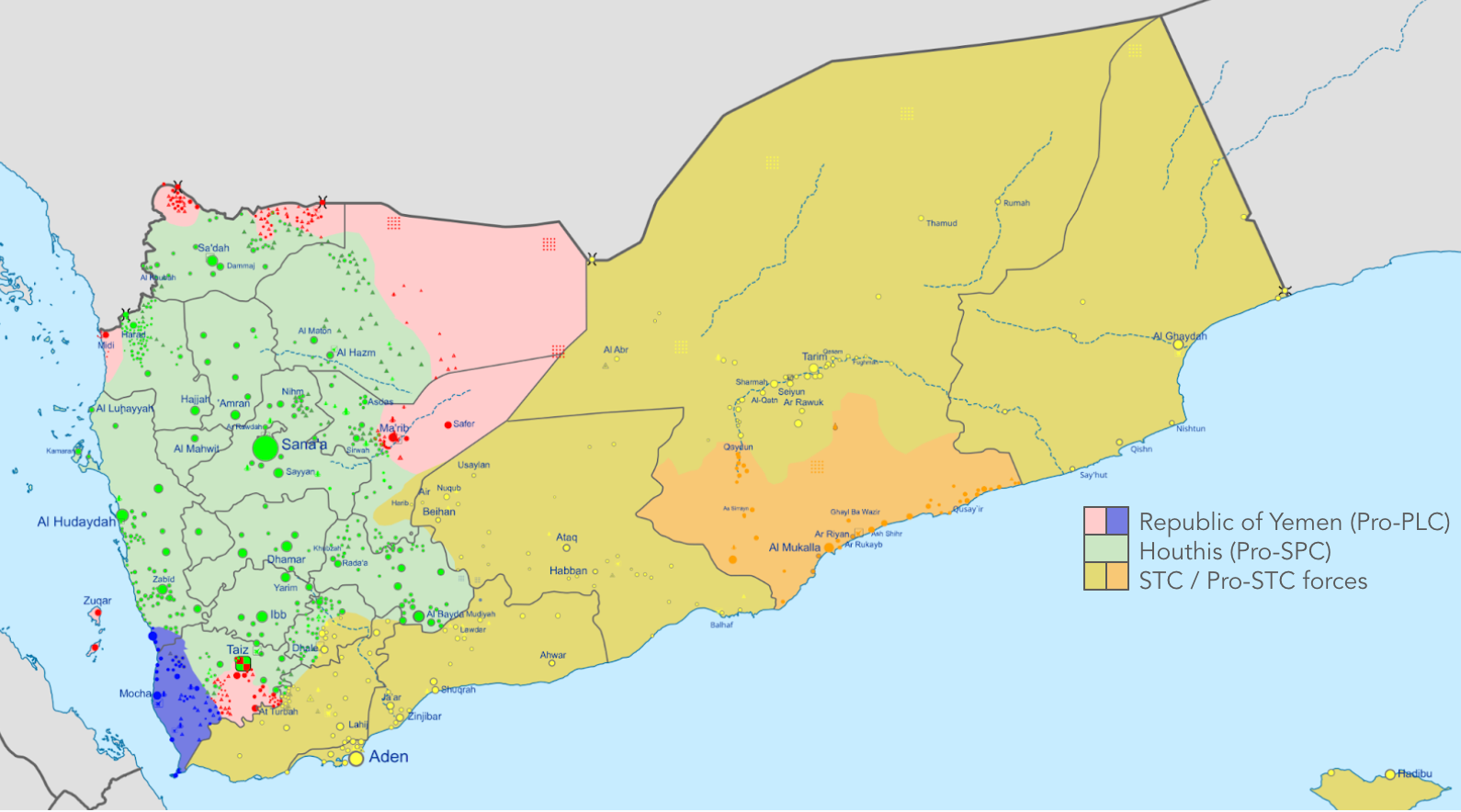
On December 2, 2025, the STC, in southern Yemen backed by the UAE, launched the offensive “Operation Promising Future,” against the Saudi Arabian-supported Hadhramaut Tribal Alliance, and U.N. recognized Yemeni Armed Forces.STC forces advanced into Hadramaut, seized PetroMasila oilfields, pushed east into Al Mahra on the Omani border, and moved on strategic positions in Shabwa and along the southern coastline. Their timeline for territorial gains moved quickly, with key several events including:
On December 3, STC units, including the Hadrami Elite Forces, shelled the First Military Region headquarters in Seiyun, followed by a ground assault seizing Seiyun’s presidential palace, Seiyun International Airport, and multiple Yemeni Army positions. Government forces withdrew within hours.
On December 4, STC forces took control of key PetroMasila oil facilities, Saudi Arabia agreed to withdraw its proxy forces. STC brokered deals in Al Mahra for government institutions in Al Ghaydah, Nishtun port, and other sites, often without fighting. The former South Yemen flag was raised over several facilities.
On December 8, STC leaders claimed control over all governorates that previously constituted defunct South Yemen and most of Yemen’s onshore oil production. Saudi‑backed government units withdrew or accepted handover deals with limited resistance.
These moves by the STC disrupt the political arrangement among anti‑Houthi partners. Shifting from a unified front against the Houthis, to infighting between the STC forces, the internationally recognized government and allied tribes. We did not identify any shifts to pro-Houthi stances and we assess this is unlikely to happen due to ideological differences and competing territorial claims.
“Operation Promising Future” also highlights a divergence between the UAE and Saudi Arabia. The UAE has deepened investment in STC forces along the southern coast and in eastern governorates, while Saudi Arabia backed the internationally recognised government, National Shield forces, and tribal alliances in Hadramaut and Al Mahra.
STC advances into Saudi‑influenced areas, combined with visible Saudi withdrawals, shifts the Gulf countries influence in Yemen and strains the former coalition.
Riyadh pressed for an STC withdrawal and redeployment under Saudi‑funded Dera Al Watan forces. We assess this move is unlikely because Saudi Arabia has reduced leverage and the STC forces maintain the positional advantage.
Territorial control of Yemen (December 10, 2025)
OUTLOOK AND RECOMMENDATIONS
Looking ahead, the security environment in Yemen remains highly volatile, prompting the U.S. State Department to maintain its Level 4 – Do Not Travel advisory, citing terrorism, civil unrest, crime, health risks, kidnapping, armed conflict, and landmines. Concentric assesses the STC forces will likely pursue efforts to stabilize the gained territory with potential long term objective of re-establishing South Yemen, which risks reigniting large scale civil conflict.
In the near term STC forces almost certainly will focus on consolidating control over newly seized territories, resume operating oil and gas facilities, and institutionalizing governance structures across former South Yemen. Emirati support, both material and political, will likely remain central for security cooperations, and economic projects along the southern coast.
Domestically there is also a heightened risk of renewed civil war as the STC may seek secessionist goals and re-establishment of South Yemen. Armed engagements between STC and the U.N. recognized government could occur, and Houthis may attempt offensive operations to capitalize on the fragmented anti-Houthi coalition.
Saudi Arabia faces limited options. Direct military confrontation with the STC is unlikely as it risks escalation with the UAE proxy and further fragmentation of the anti-Houthi camp.
Riyadh is more likely to push for renegotiation of power-sharing arrangements within the Presidential Leadership Council (PLC), seek guarantees on border security, and preserve influence in north Yemen.
Saudi Arabia may also seek to re-emphasize and place primacy on the anti-Houthi coalition to strengthen its influence in the Yemeni political landscape.
We recommend travelers and those with business interest in the region take the following steps prior to travel:
Prior to travel, it is critical to conduct comprehensive risk assessments, secure localized intelligence on political, criminal, and infrastructure-related risks, and coordinate movements with trusted local contacts or authorities.
Private security support is also strongly advised for personal safety and logistical coordination. Travelers should maintain a discreet profile, limit movements during evening hours, and ensure reliable, pre-vetted transportation is used at all times.
Travel tracking tools and secure communication channels should be employed so movements are monitored in real time by a designated security contact.
While on the ground, visitors should dress conservatively, avoid displays of wealth, and minimize solo movements. If confronted with a robbery or threat, disengaging and moving to safety should take precedence over resistance. Remaining alert to the possibility of criminals impersonating security personnel is essential for mitigating risks.